FAQ Topic: Certificate of completion
Certificate Renewal — Quick Guide
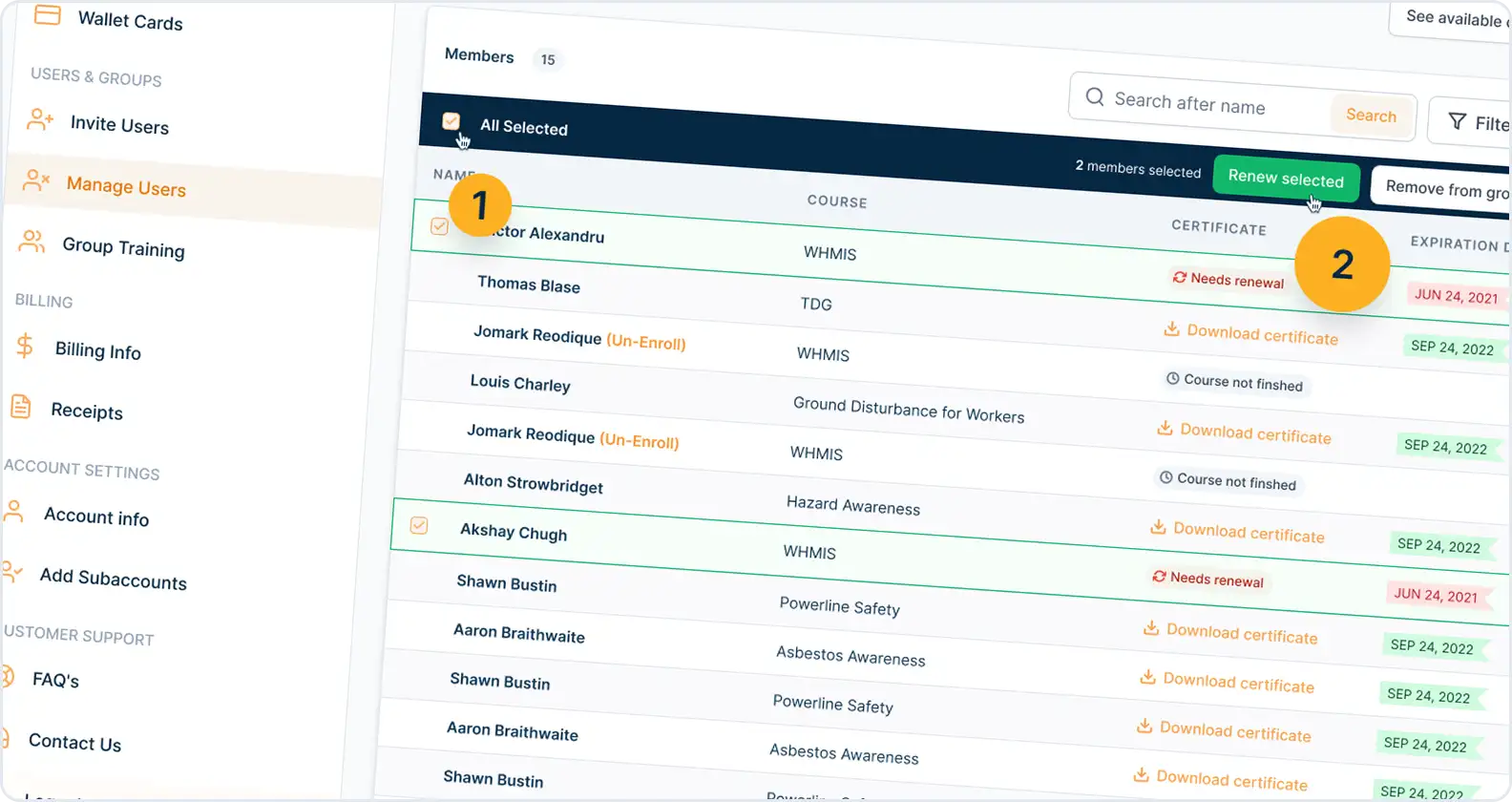
Renew expiring certificates for one or many users in just two clicks.
Steps
- Log in and open Manage Users from the left menu.
- Filter Status → Needs Renewal (or search by name).
- Select users:
- Tick the header checkbox for everyone, or
- Tick/untick rows to refine the list.
- Click Renew Selected.
How can I verify a certificate's validity?
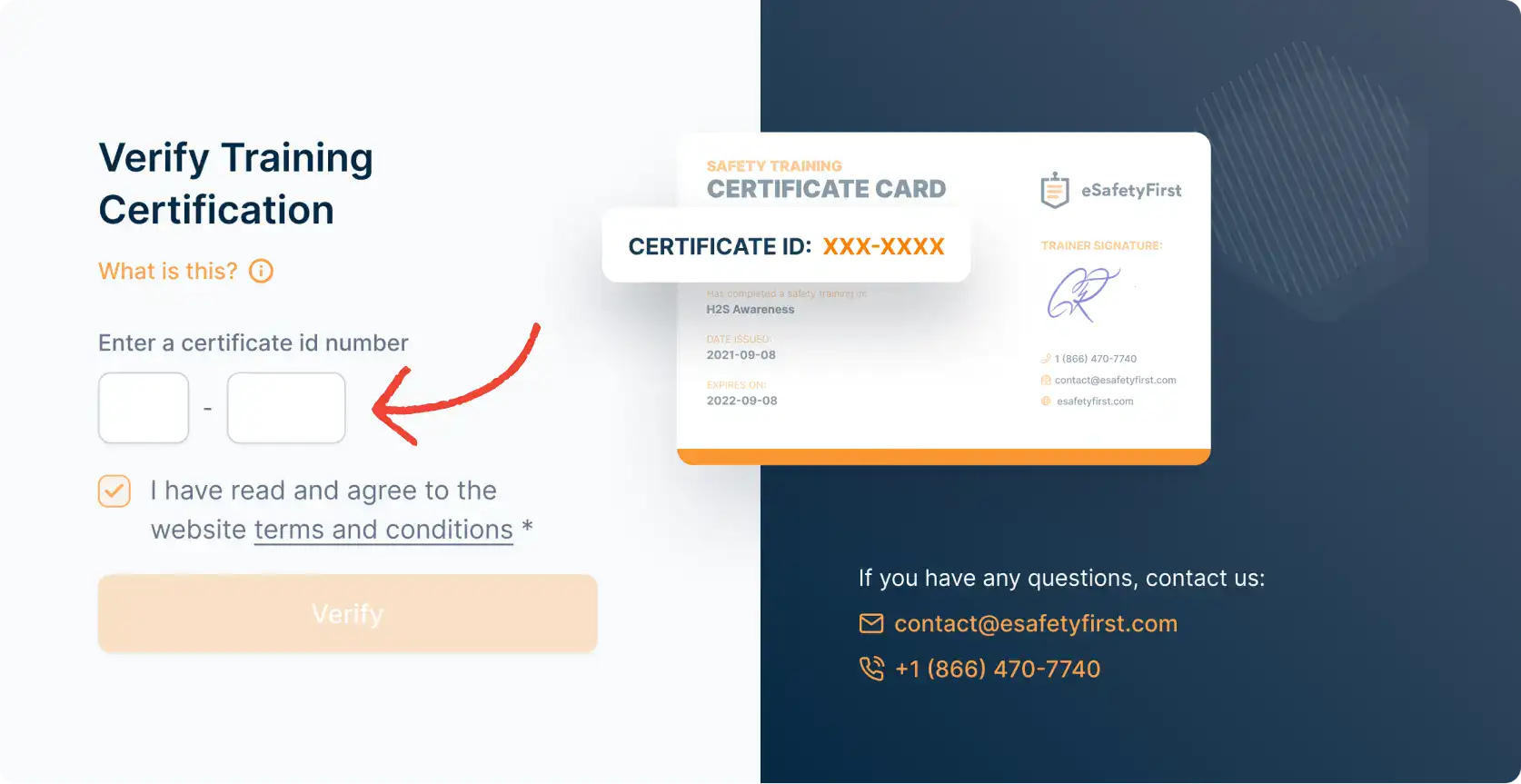
Every certificate issued by eSafetyFirst Canada carries a unique certificate ID, shown on both the electronic and the printed copy.
Enter that number on our Verify Certification Page and it will display the matching record from our database.
If your certificate was issued by a different company, you will need to contact them to confirm the document’s validity — private companies do not share training records with each other.
How can I obtain a certificate?
A certificate of completion is issued the moment you finish the course.
Each course is structured into learning sections and testing sections. To finish, you — or the person you invited to take the program — must work through all the required learning sections and score at least 80% in the testing sections.
At the end of the program, your certificate becomes available to download and print, and our system also emails you a copy.

What can I do if I have the wrong name on the certificate?
A certificate records who actually took the training, so a course finished under the wrong identity cannot be reissued to a different person. A spelling correction, on the other hand, is easy.
When a course is purchased, two options appear next to the course name: i) “Start Course” — begins the training under the name entered at checkout. ii) “Train Someone Else” — asks for the first name, last name and (optionally) email address of the worker who should take the course.
If you bought the program for someone else, click “Train Someone Else” before starting. This is explained in the welcome email, the videos, the FAQ section of the user dashboard and the dashboard notification box.
Each certificate is issued from the record of training — progress through the material and testing results. If the course is finalized under the wrong name despite those safeguards, we cannot move the certificate to another person.
If the problem is only spelling — Sam Dubroki instead of Sam Dubrovski, say — our support team will gladly correct it.

X. did not accept my certificate. Why is that?
Usually for one of four reasons: a hands-on requirement, province-specific rules, an awareness-level program, or the wrong kind of defensive driving course. Here is each.
Problem #1: Missing hands-on practice and evaluation.
For some courses the standards require only theoretical training and evaluation. Others also require hands-on practice and evaluation, provided by the employer, a supervisor or another competent person against the job-specific tasks.
Where a course needs that additional step, our presentation includes the hands-on evaluation checklist from the appropriate CSA standard — but theoretical training is never a substitute for the hands-on practice itself.
Problem #2: Fall Protection in Newfoundland and Ontario.
In Ontario, contractors and any construction-related work require the regional “Working at Heights” (WAH) certification, delivered as a classroom course.
In Newfoundland and Labrador, workers must complete a minimum 2-day WorkplaceNL-approved hands-on training course.
That in-person training falls under different legislation and must be delivered by an approved provider — our services do not include it. We make every effort to restrict access to the Fall Protection course page for these two provinces, or to inform customers about the legislation, but it remains the customer’s responsibility to buy the training they need.
Problem #3: First Aid and Food Handler certifications.
As stated on the course page and inside the course content, these two programs are informational: they provide basic theoretical training and evaluation plus an overview of how requirements differ by province, and they will not meet workplace or government certification requirements.
If you need Level 2 or Level 3 First Aid training, we recommend Red Cross Canada. If you need a Food Handler certification, we recommend FoodSafety.ca
Problem #4: Defensive Driving certification.
Our Defensive Driving course is a safety-awareness program developed around the OHS Act and Regulations, for employees who drive as part of their job. Employers use it to implement a driving-safety program in the workplace, and some clients also use it to reduce insurance costs.
It will not remove demerit points or take the N off your driver’s licence. That kind of defensive driving course has a different structure, content and testing, and is regulated by a different government body. If that is what you need, contact your province’s registry of motor vehicles for its list of approved trainers.
How can I find my certificate?
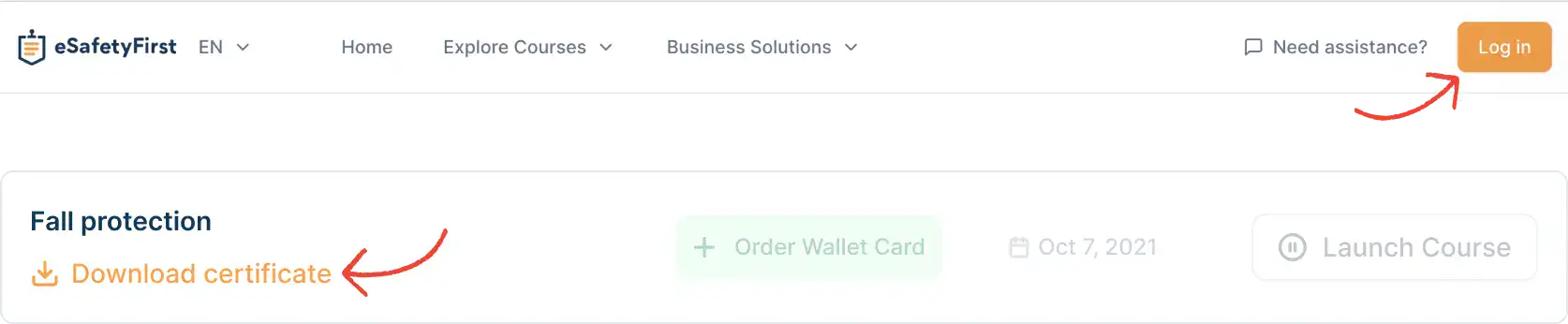
If you are an eSafetyFirst customer: log in to your account and download a copy of your certificate at any time.
If you took your training with a different company, we cannot retrieve it for you. As a private company we store only our own customers’ records, so contact the company that issued your certificate.
Why does my certificate have this expiration date?
Your certificate’s expiration date comes from the standard your course is trained against — and it varies by program. Many programs run three years, others one or two, and for WHMIS the period depends on your province: one year in Ontario, three years everywhere else.
Elevating Work Platform varies by province too, in the other direction: five years in Ontario — where the province’s new elevating work platform regulation, in force January 1, 2027, sets a five-year validity for operator training — and three years in other provinces.
Some programs’ periods also differ by province, or by company size and registration status. Our system personalizes the expiration date to your province, but you may still notice a difference between your local legislation and the date printed on your certificate or wallet card.
Where that happens, the legislation wins: you do not need to renew earlier than your province requires.
I cannot open the certificate. What can I do?
Your certificate is a PDF file. If your device cannot open PDFs, install the free Adobe Acrobat Reader, then download the certificate again and print it if you need a paper copy.