WHMIS Labels: Supplier vs Workplace Labels Explained
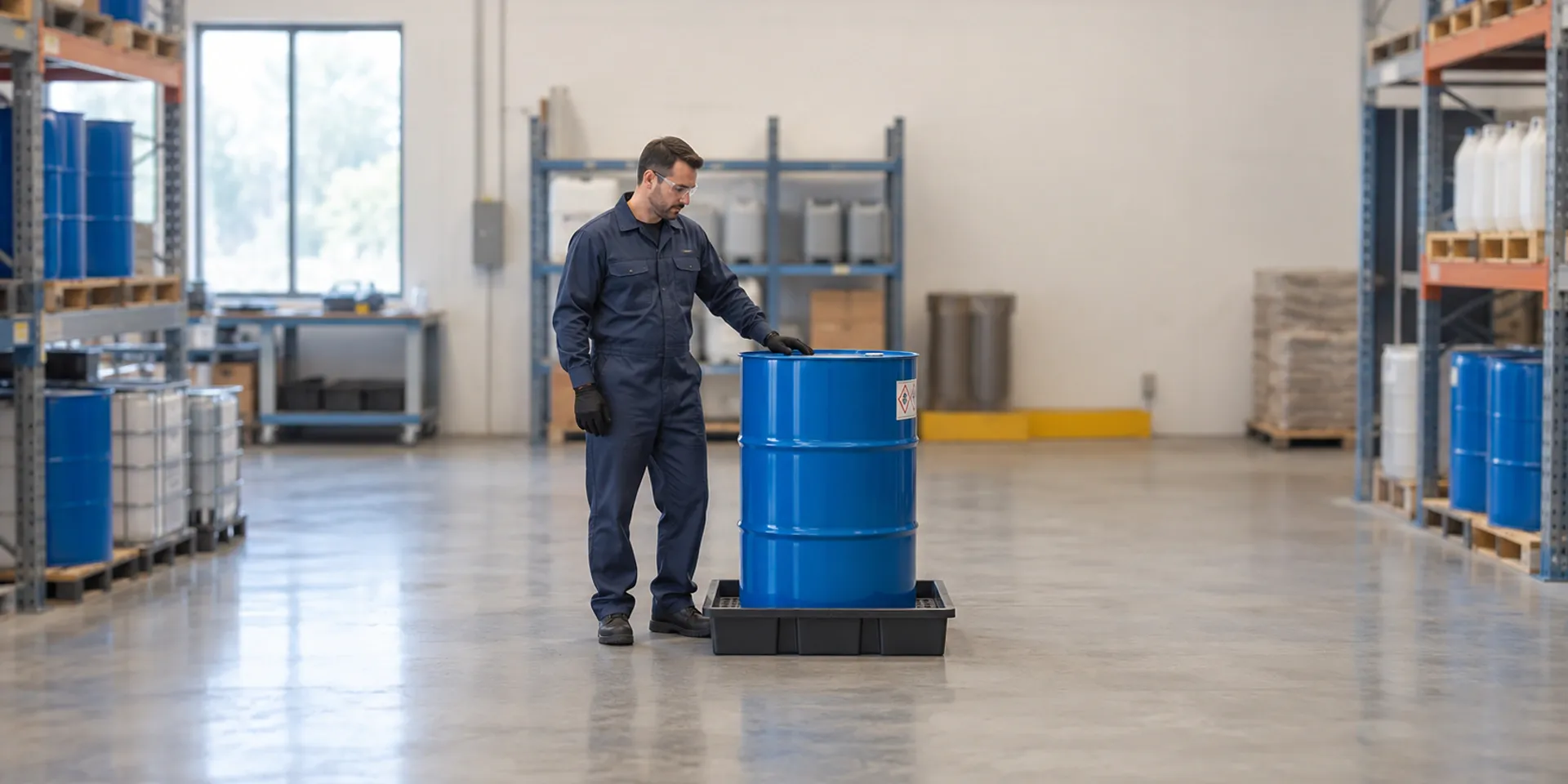
Hazardous products used in Canadian workplaces must carry a WHMIS label, with a few narrow exceptions — and there are exactly two types of label. Supplier labels arrive on the product and must show six required elements, in English and French; workplace labels are created on site when you decant or produce a product, and need three. Labels are one of the components of WHMIS. Here is what each must show, when each is needed, and the exemptions that apply. 1
What are the six required elements of a supplier label?
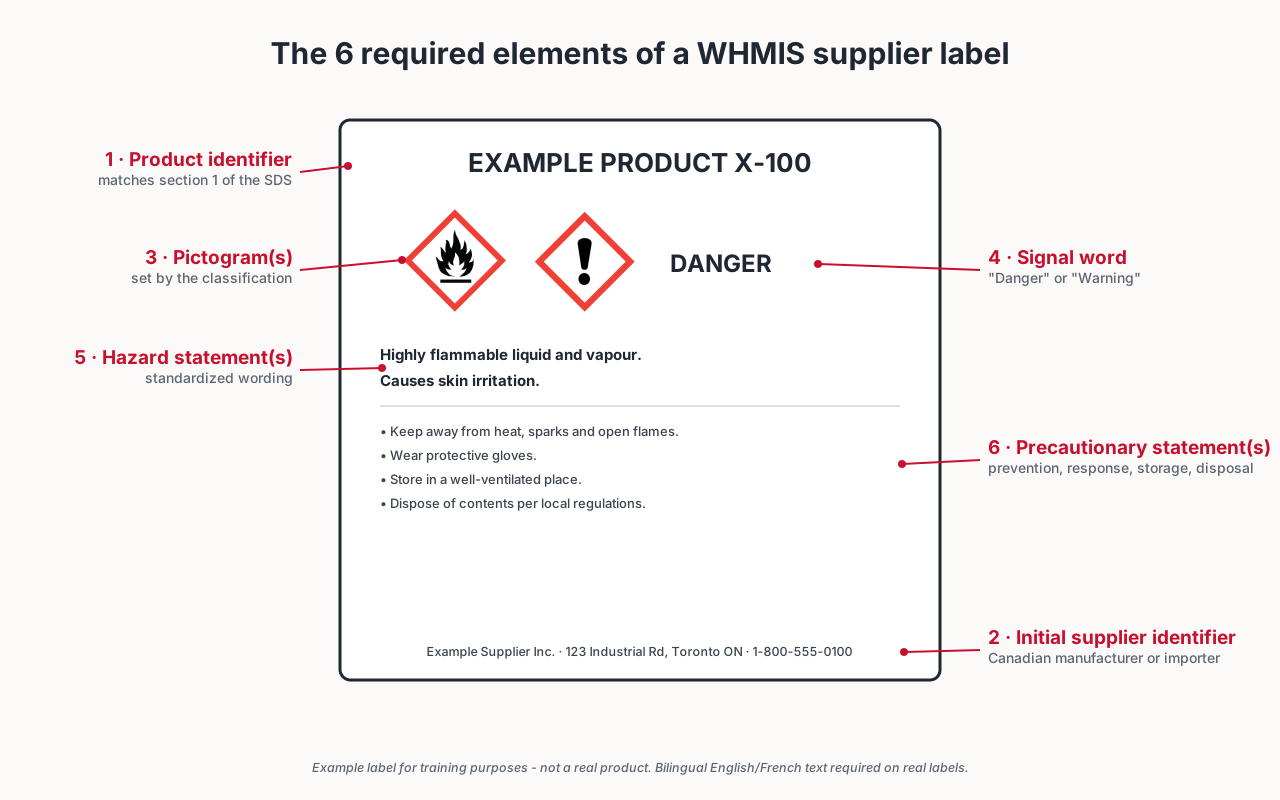
A supplier label must show six required elements, set by federal law. It is applied by the manufacturer, importer or distributor before the product reaches you. The six elements are: 1
- Product identifier — the brand, chemical, common, generic or trade name, exactly matching the name in section 1 of the safety data sheet.
- Initial supplier identifier — the name, address and telephone number of the Canadian manufacturer or the Canadian importer.
- Pictogram(s) — the hazard pictograms assigned by the product's classification, in a red square set on one of its points. Some classifications require none.
- Signal word — "Danger" for the more severe hazards, "Warning" for the less severe. Some hazard classes and categories have no signal word.
- Hazard statement(s) — standardized sentences describing the hazard, such as "Extremely flammable gas" or "May cause cancer".
- Precautionary statement(s) — standardized advice on prevention, response, storage and disposal, such as "Wear protective gloves" or "Keep container tightly closed".
Two further rules apply to every supplier label. It must be bilingual — the information must appear in both English and French, either as one bilingual label or as two unilingual parts that together make it up; an English-only label does not comply, even if it is fully compliant in the United States. And the pictogram, signal word and hazard statements must be grouped together, clearly displayed, and legible. 1
Some products also carry supplemental label information required by their classification — for example, a mixture containing 1% or more of an ingredient of unknown acute toxicity must state that percentage. Supplemental information may not contradict or detract from the required elements. 2
Why do so many sources say seven?
Under WHMIS 1988, supplier labels had seven elements, and the list was different from today's: it included a statement that a material safety data sheet was available and used risk phrases and separate first-aid measures, with no signal word. 4 WHMIS 2015 dropped the SDS statement from the supplier label; on the workplace label it remains one of the three required elements, as it was under WHMIS 1988. 5 Older training materials and exam banks still teach seven. 1
When is a workplace label required, and what must it include?
You need a workplace label in three situations: when a hazardous product is produced in the workplace and used there; when a product is decanted — poured, transferred or repackaged — into another container; and when a supplier label is lost, damaged or no longer legible. The label is created by the employer, on site. 1
A workplace label has three required elements: 1
- Product name — matching the name on the safety data sheet.
- Safe handling information — which may include pictograms or other information taken from the supplier label.
- A reference to the matching safety data sheet, where one is available.
There is no prescribed format. A workplace label can be a printed sticker, a tag, a placard, a stencil, a stamp or a marking, as long as workers are trained to recognize the system in use and it stays legible. 1
There are two narrow exceptions in the federal regulations. If a product is poured into a container and used immediately by the person who poured it, no label is required. If it stays under the control of that person and is used only during the shift in which it was filled, a full workplace label is not required, but the container must still be identified with the product name. 6 If anyone else will handle it, or it will outlive the shift, label it properly. Workplace label requirements are set by your province, territory or the Canada Labour Code, and many employers set internal rules that go beyond the minimum.
How does a supplier label compare with a workplace label?
| Criterion | Supplier label | Workplace label |
|---|---|---|
| Who creates it | Supplier — manufacturer, importer or distributor | The employer |
| Required elements | 6 | 3 |
| Language | English and French, always | Set by the jurisdiction; must be understood by the workers using it |
| Format | No set layout, but pictogram, signal word and hazard statements must be grouped, legible and clearly displayed | No prescribed format — sticker, tag, placard, stencil, stamp or marking |
| When required | On every hazardous product at the time of sale or importation | Product produced on site; product decanted into another container; supplier label lost or illegible |
| Legal basis | Hazardous Products Act 3 and Hazardous Products Regulations 2 (federal) | Provincial, territorial or federal OHS legislation |
| When it must be updated | Within 180 days of the supplier becoming aware of significant new data (HPR 2) | Whenever the supplier information it is based on changes |
The 180 days is a temporary exemption, not a grace period in which nothing happens: until the corrected label ships, the supplier must supply the required changes to purchasers in writing — the same mechanism as the 90-day rule for safety data sheets, covered with the SDS update rules. Once the period expires, the corrected label is required outright. 2
When is a WHMIS label not required?
A WHMIS label is not required in a few narrow cases, and knowing them prevents both over-labelling and false confidence. A WHMIS label is not required where:
- The product is used immediately by the person who poured it, from the container they poured it into (no label is required in that case). The product name is required when the container is used only by that person during the shift in which it was filled. 6
- Pipes, process vessels and tank cars — a hazardous product in a pipe, piping system, process vessel, tank car or similar is identified by other means, and workers must be trained on the identification system used instead. 1
- The outer container of a multi-container package, where the inner label is visible and legible through it, or where the outer container carries a compliant Transportation of Dangerous Goods label. This does not apply when the outer container is the only container. 2
- Small containers get partial relief rather than an exemption: containers of 100 mL or less are exempt from carrying hazard and precautionary statements, and containers of 3 mL or less may use a label that is removable during use where a permanent label would interfere. 2
Whole product families — consumer products, explosives, pest control products and others — are excluded from the federal supplier rules altogether; 3 the full list and what it means for employers is covered under employer labelling duties. One caution that catches employers out: an exclusion from WHMIS labelling is not an exclusion from the duty of care — a consumer product bought at a hardware store and used at work still carries hazards, and workers must still be trained on its safe use.
What are the common labelling mistakes inspectors find?
The common findings are unlabelled decanted containers, illegible or outdated supplier labels, labels that do not match the SDS, unilingual imported labels and workplace labels with no SDS reference. Labelling is where WHMIS programs usually fail an inspection — not because employers don't know the rules, but because labels degrade quietly between audits. These are the findings in detail:
- Unlabelled decanted containers. The spray bottle filled from the drum, the jerrycan of solvent by the workbench, the parts-washer refill. This is a common finding.
- Illegible supplier labels. Solvent splash, abrasion, sun bleaching and shrink-wrap residue make labels unreadable long before the product is used up. A label you cannot read is legally a missing label, and the employer must replace it.
- Labels that do not match the SDS. The product name on the container and the product identifier in section 1 of the safety data sheet must be the same. Reformulations and supplier changes break the match without anyone noticing.
- Outdated supplier labels after the HPR amendments. Stock bought before the December 2025 transition deadline may carry classifications and label elements that no longer reflect the current regulations. 7 Old stock is not automatically non-compliant, but the SDS on file must be current.
- Unilingual labels on imported product. English-only labels from US suppliers are common and do not meet Canadian requirements — and if you import for your own use, the obligation to produce a compliant bilingual label is yours.
- Workplace labels with no SDS reference. Three elements, and this is the one people drop — usually because the template only had room for two.
Who must make sure workers can read WHMIS labels?
The employer. Workers who handle labelled products must be able to read both kinds of label and act on them, and that is part of the WHMIS education and training the employer is legally required to provide. Label recognition is also tested in WHMIS certification.
Resources & Guides
- 1CCOHS, WHMIS: Labels
- 2Hazardous Products Regulations (SOR/2015-17), label provisions, s. 5.12 significant new data, s. 5.4 small-capacity containers
- 3Hazardous Products Act (R.S.C., 1985, c. H-3), Schedule 1 exclusions
- 4Controlled Products Regulations (SOR/88-66, repealed 2015), archived text, WHMIS 1988 label requirements
- 5
- 6Canada Occupational Health and Safety Regulations (SOR/86-304), s. 10.37, portable containers
- 7
Last updated: October 21, 2026