What Does WHMIS Stand For? Components & Legislation Explained
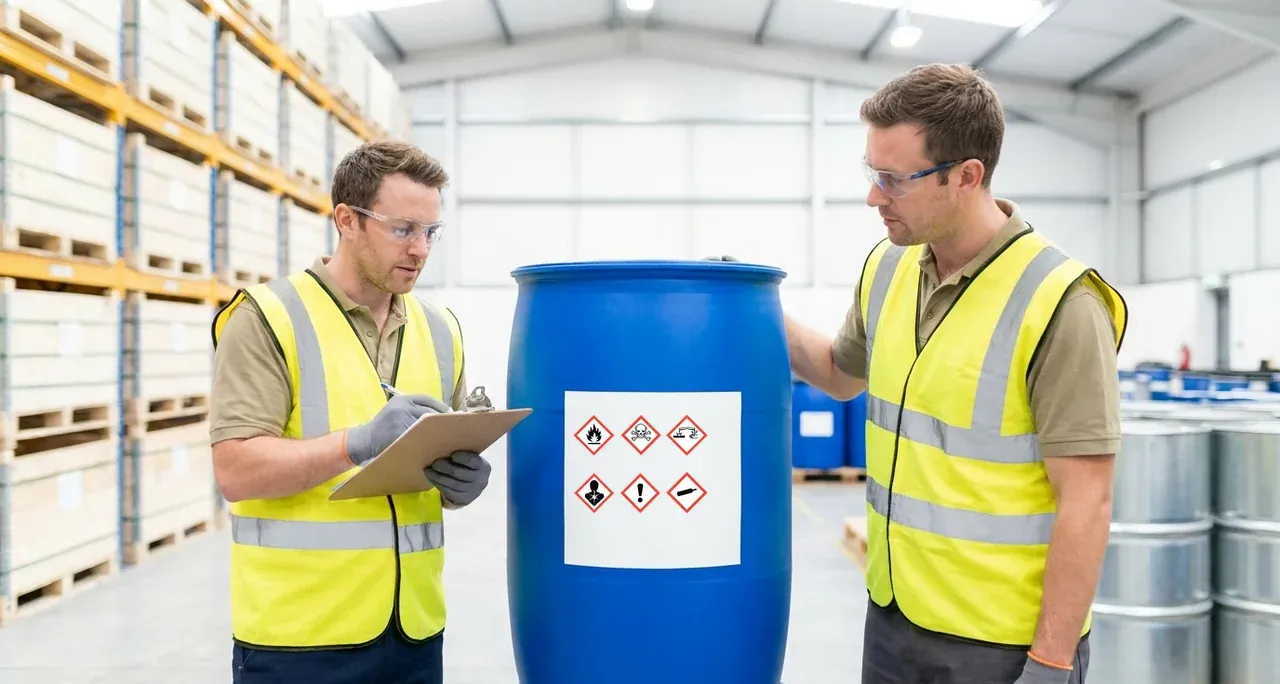
PLAY VIDEO
10:12
While this informational page discusses various aspects of WHMIS definition, legislation, changes and training requirements, our company also offers WHMIS training services.
For more information, please consult the WHMIS product page.
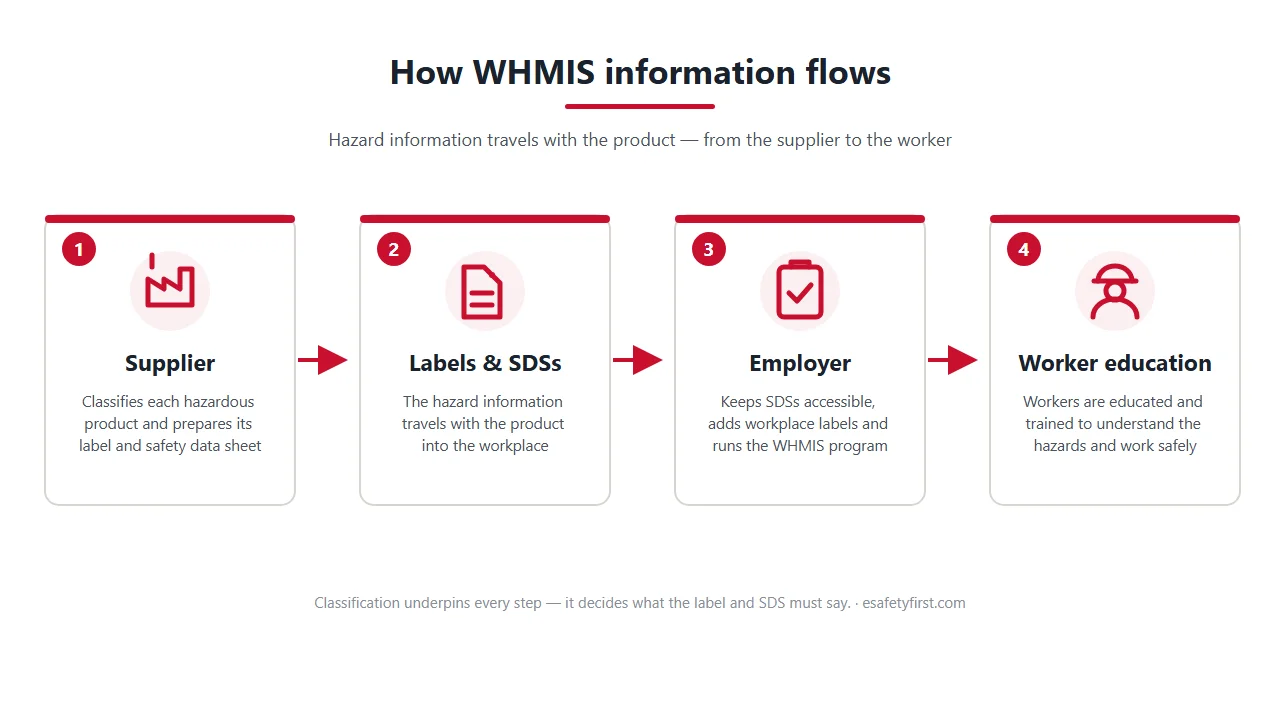
WHMIS — the Workplace Hazardous Materials Information System — is Canada's national standard for communicating chemical hazards in the workplace. It's often described as having three main components — labels, safety data sheets (SDSs), and worker education — built on hazard classification as the underlying system, which is why some sources count four. WHMIS is law across Canada: federally through the Hazardous Products Act and Regulations, and in every province and territory through OHS legislation that requires employers to train exposed workers. Since 2015 it's aligned with the global GHS standard. This guide covers what WHMIS stands for, each component, and the legislation behind it.
What is WHMIS?
WHMIS stands for the Workplace Hazardous Materials Information System — Canada's national standard for communicating the hazards of workplace chemical products. It is a coordinated system, not a single law: suppliers classify hazardous products and provide labels and safety data sheets, and employers use that information to train the workers who handle those products. 1
The name describes exactly what it does:
- Workplace — WHMIS covers products used, handled or stored at work. Products sold to the public are labelled under separate consumer legislation.
- Hazardous Materials — dangerous products that can cause fire, explosion, or short- and long-term health harm: flammables, oxidizers, corrosives, acutely toxic substances, and biohazardous infectious materials, among others.
- Information System — the flow of that hazard information from supplier to employer to worker, through classification, labels, SDSs and training.
What is the purpose of WHMIS?
The purpose of WHMIS is to make sure employers and workers get consistent health and safety information about the hazardous products they may be exposed to at work. By standardizing hazard classification, container labelling, safety data sheets and worker education, WHMIS is designed to reduce the injuries and illnesses those products cause. In practice it gives every Canadian worker the same right to know, whatever the province and whatever the industry. 1
The components of WHMIS: three or four?
WHMIS is often described as having three main components — labels, SDSs, and worker education — built on hazard classification as the underlying system, which is why some sources count four. Both counts describe the same standard: classification is the foundation the other three sit on rather than something a worker interacts with directly. 1
Hazard classification
Before anything is labelled, the product has to be classified. Suppliers compare each product against the criteria in the Hazardous Products Regulations and place it in one or more hazard classes — flammable liquids, acute toxicity, skin corrosion, and so on — and then in a category, and in some cases a subcategory, that reflects severity. Category 1 is more severe than Category 4. 3
Everything downstream follows from this step: the classification determines which pictograms appear, which signal word is used, and which hazard and precautionary statements are printed. Classification is a supplier duty under federal law, not an employer judgement call.
Pictograms
Pictograms are the red-bordered diamond symbols that flag, at a glance, what makes a product dangerous. Where the product's classification calls for one, it appears on the supplier label and on the safety data sheet — sometimes more than one, sometimes none at all. There are ten symbols you may see on Canadian labels, and each has a precise meaning: see all 10 WHMIS pictograms explained.
Labels
Labels are the first alert a worker gets about a product's hazards, and there are two kinds — supplier and workplace labels explained in full. A supplier label arrives on the product from the manufacturer, distributor or importer and carries the standardized elements its classification requires, in English and French.
A workplace label is created on site when a product is decanted, produced in the workplace, or when the supplier label is lost or unreadable. Whichever kind is in front of you, the rule is the same: do not use a product whose label is missing or illegible.
Safety data sheets (SDSs)
A safety data sheet is the detailed technical document behind a hazardous product — more information than a label can carry. It tells you what the hazards are, how to use, store and dispose of the product safely, what exposure looks like, and what to do in an emergency. Every hazardous product sold comes with one, and employers must keep them current and readily available to exposed workers.
Under WHMIS every SDS has the 16 sections of a safety data sheet in the same order, so once you can read one, you can read all of them.
Worker education and training
The fourth component is the one that turns information into safety. WHMIS draws a distinction worth knowing: education is the portable, general part that travels with you between jobs, while training covers your own workplace's products and procedures. 6
Employers must provide both — and the test of whether it worked is whether a worker can answer the four basic questions about every product they handle, set out in WHMIS responsibilities for employers.
WHMIS legislation in Canada
WHMIS is implemented by complementary federal, provincial and territorial legislation. The federal layer governs suppliers; the provincial and territorial layer governs employers. Both apply to most Canadian workplaces at once.
Federal legislation
Federal WHMIS law requires suppliers of hazardous products intended for use, handling or storage in a workplace to classify those products and pass health and safety information to their customers. The Hazardous Products Act (HPA) sets the framework and the prohibitions; the Hazardous Products Regulations (HPR) set the classification criteria and the exact content of labels and safety data sheets. Health Canada administers and enforces both. 23
For workplaces that are themselves federally regulated — banks, airlines, railways, telecommunications, federal Crown corporations — the employer duties come from the Canada Labour Code Part II and Part X, Division III of the Canada Occupational Health and Safety Regulations, enforced by the ESDC Labour Program. 4
Provincial and territorial legislation
Provincial and territorial WHMIS law requires employers to obtain hazard information from their suppliers and use it to train their workers, label products in the workplace, and keep SDSs accessible. The requirements are built on a common national model — what changes is which statute they live in and who inspects you. Here is where WHMIS sits in each jurisdiction:
| Jurisdiction | Where WHMIS lives (act / regulation) | Enforced by |
|---|---|---|
| Federal — suppliers | Hazardous Products Act; Hazardous Products Regulations (SOR/2015-17) 3 | Health Canada |
| Federal — workplaces | Canada Labour Code, Part II; Canada Occupational Health and Safety Regulations, Part X, Division III 4 | ESDC Labour Program |
| Alberta | Occupational Health and Safety Act; OHS Code, Part 29 — WHMIS, ss. 394.1–414 9 | Alberta OHS — Jobs, Economy, Trade and Immigration |
| British Columbia | Workers Compensation Act; OHS Regulation (BC Reg 296/97), Part 5, ss. 5.3–5.18 10 | WorkSafeBC |
| Manitoba | The Workplace Safety and Health Act; Workplace Safety and Health Regulation (M.R. 217/2006), Part 35 11 | Workplace Safety and Health — Manitoba Labour and Immigration |
| New Brunswick | Occupational Health and Safety Act; WHMIS Regulation (N.B. Reg. 2016-6) 12 | WorkSafeNB |
| Newfoundland and Labrador | Occupational Health and Safety Act; WHMIS Regulations, 2018 22 | OHS Division — Digital Government and Service NL |
| Northwest Territories | Safety Act; Occupational Health and Safety Regulations (R-039-2015), Part 22 14 | WSCC |
| Nova Scotia | Occupational Health and Safety Act; Workplace Health and Safety Regulations, Part 3 — WHMIS 15 | Department of Labour, Skills and Immigration |
| Nunavut | Safety Act; Occupational Health and Safety Regulations (R-003-2016), Part 22, s. 322 ff. 16 | WSCC |
| Ontario | Occupational Health and Safety Act; R.R.O. 1990, Reg. 860 — WHMIS 17 | Ministry of Labour, Immigration, Training and Skills Development |
| Prince Edward Island | Occupational Health and Safety Act; WHMIS Regulations 18 | Workers Compensation Board of PEI |
| Quebec | Act respecting occupational health and safety (CQLR, c. S-2.1); Hazardous Products Information Regulation (CQLR, c. S-2.1, r. 8.1) 23 | CNESST |
| Saskatchewan | The Saskatchewan Employment Act, Part III, Division 7 (ss. 3-47 to 3-51); The Occupational Health and Safety Regulations, 2020, Part 22 20 | OHS Division — Ministry of Labour Relations and Workplace Safety |
| Yukon | Workers' Safety and Compensation Act; WHMIS Regulations | Workers' Safety and Compensation Board 21 |
Two practical points if you operate in more than one province. Supplier labels and SDSs must be bilingual — English and French — everywhere in Canada, because that requirement comes from the federal supplier rules. And in every jurisdiction the underlying test for training is comprehension: instruction delivered in a language your workers do not understand does not discharge the duty. Employers in every jurisdiction must train exposed workers, label products in the workplace, and keep SDSs accessible; the full set of WHMIS responsibilities for employers is set out separately.
WHMIS 1988 → 2015: what changed and why
WHMIS was introduced in 1988 primarily to give Canadian workers a consistent, national right to know about the hazardous materials they work with. Before it, hazard information depended on the supplier and the province. In 2015 the system was updated to align with the global GHS standard, and the updated system is called WHMIS 2015. 8
The trigger was the publication of the Hazardous Products Regulations on 11 February 2015, alongside amendments to the Hazardous Products Act. The main changes were:
- More comprehensive hazard classification criteria, better able to indicate severity.
- New hazard classes, and hazard categories and subcategories within them.
- New supplier label requirements — GHS pictograms in red diamonds, the signal words "Danger" and "Warning", and standardized hazard and precautionary statements. The WHMIS 1988 hatched border is no longer required.
- A standardized 16-section safety data sheet format, replacing the shorter nine-category MSDS.
The regulations have since been amended again — the current rules took effect in December 2022, and the supplier transition ended in December 2025. For what changed and what it means for suppliers and employers, see how GHS works in Canada.
WHMIS training: who needs it and how it works
If a workplace uses hazardous products, Canadian law requires a WHMIS program, and the workers exposed to those products must be educated and trained.
Who needs WHMIS training — and is it mandatory?
WHMIS training is mandatory in every province and territory for anyone who works with, or may be exposed to, a hazardous product. That is broader than it sounds: it covers people who use, store, handle or dispose of hazardous products, people who may be exposed during normal work or maintenance, supervisors and managers of those workers, and anyone involved in emergency response. The legal wording differs by jurisdiction — see the legislation table above for the statute that applies to you — but the duty does not.
Hazardous products are most common in agriculture and food processing, automotive and manufacturing, construction, energy and utilities, warehousing and logistics, mining, oil and gas, pharmaceuticals and healthcare, and waste management. The requirement follows the product, not the industry: an office that stores a classified cleaning product in a supply room is covered too.
Can you do WHMIS training online?
Yes. WHMIS education is theoretical — hazard classes, pictograms, labels, SDSs — so it can be delivered in a classroom or online, and online delivery is held to the same standard. A well-built online course covers the required material in about 1 hour 45 minutes and can be taken in shifts, which is usually cheaper and easier to schedule than an in-person session. If you want to check where you stand first, try our free WHMIS practice test.
What online delivery cannot do is replace the site-specific half: your employer still has to train you on the actual products, procedures and emergency plans in your workplace, and employers choose the level and format of training appropriate to their site.
Is there free WHMIS training?
Real WHMIS education is rarely free. Free introductions exist — some employers build their own program and deliver it at no cost to their workers, and free preview material is easy to find. What doesn't come free is a recognized certificate with a verifiable record behind it: keeping a course aligned with the current regulations and issuing traceable certificates costs money, so providers charge for it.
If you're comparing options, look at what the price actually buys — current content, a printed certificate and wallet card, and completion records your employer can produce when an inspector asks.
Who is responsible for training?
The employer. In every Canadian jurisdiction the legal obligation to develop, implement and maintain a WHMIS education and training program sits with the employer, and it stays there even when the training itself is bought from an outside provider — the employer is responsible for confirming that the provider is competent and that the program actually meets the workplace's needs. The full picture is set out in WHMIS responsibilities for employers.
Working with the health and safety committee matters here too. For example, in Ontario the OHSA requires WHMIS instruction to be developed and reviewed in consultation with the committee or health and safety representative 7; CCOHS recommends the same consultation everywhere. Workers have duties as well: to participate in the training, and to follow the safe work procedures it teaches.
Your WHMIS certificate: validity, renewal, and records
A WHMIS certificate does not legally expire — no federal or provincial law sets an expiry date on WHMIS education. What the law requires instead is that workers stay competent: CCOHS's guidance is that education and training are required "as needed to protect the worker's health and safety" — when a worker is new to the site, when new hazardous products arrive, when processes change — and that the employer should review the WHMIS program at least annually. 6
In Ontario, that review rhythm is statutory: the Occupational Health and Safety Act requires employers to review a worker's training and instruction, and the worker's familiarity with it, at least annually — more often if circumstances change. 7
Your eSafetyFirst certificate carries a printed expiry date so employers have a date to manage refresher training against: one year for Ontario, matching the annual review the OHSA requires, and three years everywhere else. Treat the printed date as the backstop and the workplace triggers above as the real schedule.
WHMIS at a glance: key takeaways
- WHMIS stands for the Workplace Hazardous Materials Information System — Canada's national hazard communication standard for chemical products used at work.
- It has three main components — labels, safety data sheets and worker education — built on hazard classification, which is why you'll also see it counted as four. Both descriptions are correct.
- It is law everywhere in Canada — federally through the Hazardous Products Act and Regulations for suppliers, and through provincial and territorial OHS legislation for employers.
- Since 2015 it has been aligned with GHS, the global classification and labelling system, and the regulations were amended again in 2022.
- Nine pictograms are assigned under WHMIS, plus the environment pictogram, which is optional in Canada — ten symbols in total that you may see on a Canadian label.
- A WHMIS certificate has no legal expiry date, but employers must keep workers competent — review the program regularly and retrain when products or processes change. The eSafetyFirst certificate prints a one-year expiry for Ontario and three years elsewhere.
Whether you're adding the credential yourself or getting a team compliant, the eSafetyFirst WHMIS course covers the education half online.
Hazard classes, all ten pictograms, labels and SDSs — with the certificate issued the moment you pass, and records your employer can pull any time.
Resources & Guides
- 1CCOHS, WHMIS: General
- 2
- 3
- 4
- 5CCOHS, WHMIS: Legislation
- 6
- 7
- 8WHMIS.org, Canada's National WHMIS Portal (CCOHS)
- 9
- 10
- 11
- 12
- 13
- 14
- 15Nova Scotia Workplace Health and Safety Regulations, Part 3, WHMIS
- 16
- 17Ontario R.R.O. 1990, Reg. 860, WHMIS
- 18
- 19
- 20Saskatchewan WHMIS provisions, SEA Part III, Div. 7 + OHS Regulations, 2020, Part 22 (WHMIS.org)
- 21Yukon WHMIS Regulations, Workers' Safety and Compensation Board
Last updated: August 31, 2026