Arc Flash PPE: Categories, Boundaries & Arc Ratings in Canada
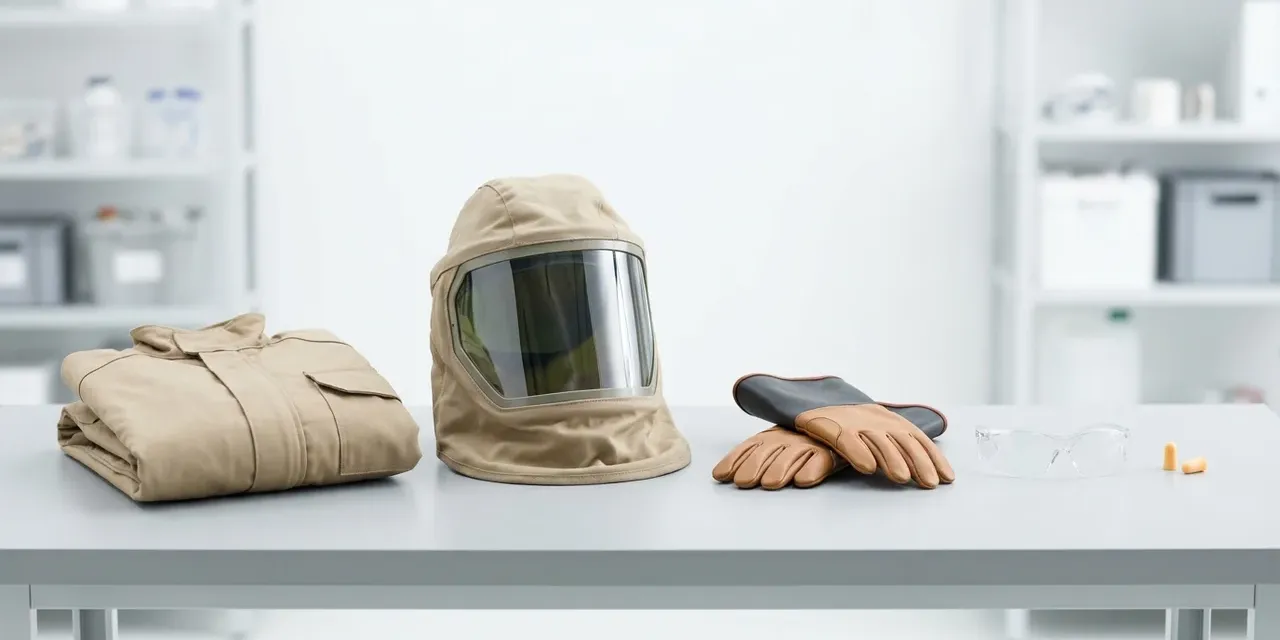
Arc flash PPE categories (1 to 4) come from NFPA 70E. Canada's CSA Z462:24 no longer uses the category numbers: it specifies minimum arc ratings for the task instead, and keeps a table-based selection method in normative Annex V. Canadian workplaces may encounter both systems, particularly at sites working to NFPA 70E or relying on legacy documentation, so this guide covers the four categories, the arc-rating approach and the boundary rules.
Whichever system a site works to, the starting point is the same. The arc flash risk assessment establishes how much incident energy a worker could be exposed to at a given task, and the protection selected has to meet or exceed that figure. From there, Z462:24 offers two routes. An incident-energy analysis produces a calculated value that is compared against the arc rating of the PPE. The table-based method in Annex V returns the minimum arc rating required for the task without a site-specific calculation. The two routes are alternatives, not a pair — CCOHS puts it plainly: “While either method can be used, only one method should be used at a time” on the same piece of equipment 1.
How are the four arc flash PPE categories defined?
The four PPE categories come from NFPA 70E 3. Each one sets a minimum arc rating in cal/cm² and the clothing and equipment that goes with it.
| Category | Minimum arc rating | Typical PPE examples |
|---|---|---|
| CAT 1 | 4 cal/cm² | Arc-rated long-sleeve shirt and pants (or coverall), arc-rated face shield or hood |
| CAT 2 | 8 cal/cm² | Arc-rated shirt and pants, arc-rated face shield with balaclava or an arc-rated hood, heavy-duty leather or arc-rated gloves |
| CAT 3 | 25 cal/cm² | Arc-rated flash-suit jacket, pants and hood, arc-rated gloves, safety glasses, hearing protection |
| CAT 4 | 40 cal/cm² | Full flash suit (jacket, pants and hood), arc-rated gloves — or rubber insulating gloves with protectors where shock protection is also required — face, hearing and foot protection |
This column gives typical examples, not a complete PPE prescription, and it is not a substitute for the standard. The NFPA 70E tables also address head, eye, hearing and foot protection depending on the task.
Hand protection deserves particular care, because it is commonly misread. Heavy-duty leather gloves appear as an arc-flash option at the two lower categories only. At CAT 3 and CAT 4 the hand protection is arc-rated gloves, or rubber insulating gloves with protectors where shock protection is required as well. Note the wording: both CSA Z462:24 and the current NFPA 70E say “protectors” rather than “leather protectors”, because the protector no longer has to be leather. And the category number alone does not create a rubber-glove requirement — that comes from the shock hazard, not the arc flash one.
A category number is not a measure of how dangerous a task is on its own. It is shorthand for the minimum arc rating required, and it applies only where the equipment and the task fall inside the parameters of the NFPA 70E PPE category tables. Outside those parameters, an incident-energy analysis is required.
How does CSA Z462:24 handle arc ratings?
The 2024 edition of CSA Z462 removed the PPE category numbers 2. Protection is specified by minimum arc rating instead, and the table-based way of getting to a selection was retained and relocated to normative Annex V, where the former category numbers are replaced by minimum arc ratings.
Both routes are available. An incident-energy analysis produces a calculated value for the task, and the PPE selected has to carry an arc rating that meets or exceeds it. Annex V returns a minimum arc rating for the task directly, in the same way the category tables did, without the category label. Presenting incident-energy calculation as the only Z462:24 method is a common misreading of the change — and so is using both routes on the same equipment, which CCOHS warns against 1.
What do ATPV and EBT mean on a garment?
- ATPV, arc thermal performance value. The incident energy, in cal/cm², at which a fabric gives a 50 percent probability of the onset of a second-degree burn 7. A higher number means more protection.
- EBT, energy break-open threshold. The incident energy at which a fabric has a 50 percent probability of breaking open and exposing the skin beneath 7. It is reported for fabrics that break open before they reach their ATPV.
A garment label carries whichever of these two values the fabric reached first in testing. That value is the garment's arc rating, and it has to meet or exceed the incident energy determined for the task 7.
What is ARLIM?
ARLIM is the arc rating limit. Z462:24 expanded its arc-rating terminology to account for it, particularly in connection with face shields and other eye and face protection, which are tested to ASTM F2178/F2178M 8. It is not a third interchangeable garment value sitting alongside ATPV and EBT on a shirt label.
What are the arc flash boundary and the approach boundaries?
The arc flash boundary and the approach boundaries answer two different questions. One is about the heat of an arc; the other two are about electric shock.
What does the arc flash boundary mark?
The arc flash boundary is the distance at which the incident energy from an arc flash equals 1.2 cal/cm² (5 J/cm²), the level at which an unprotected person would receive the onset of a second-degree burn on bare skin, based on the Stoll model. Anyone crossing that boundary needs arc-rated protection appropriate to the incident energy at their working distance 1.
How is the arc flash boundary determined?
The arc flash boundary is not one fixed distance: where an incident-energy analysis is used, it is calculated for each piece of equipment from its available fault current and the clearing time of its protective device, the same inputs that give the incident energy at the working distance.
What are the limited and restricted approach boundaries?
The approach boundaries address the shock hazard rather than the arc flash hazard, and they are set by voltage 1.
- Limited approach boundary. The shock-hazard distance from an exposed energized conductor that an unqualified person must not cross. An unqualified person may enter only under defined conditions, which include being advised of the hazard and being escorted by a qualified person.
- Restricted approach boundary. Closer in, and for qualified persons only. Inside it, the risk of arc-over and of inadvertent movement toward the conductor increases, so entry requires a documented plan, insulation of the conductor or the worker, and appropriate PPE.
How is arc flash PPE selected under CSA Z462:24?
Selection follows the risk assessment. Where an incident-energy analysis is used, the assessment identifies the equipment, the available fault current and the clearing time of the protective device, and from those it produces the incident energy at the worker's working distance. That figure, not a site habit or a default kit, is what the arc rating has to meet or exceed. Where the Annex V table method is used instead, the table returns the minimum arc rating for the task and the same principle applies to the selection.
PPE is the last line of defence and never the first control. De-energizing and locking out remains the required approach wherever it is practicable, and arc-rated protection covers the residual risk of work that genuinely has to be done energized 4,5.
Arc-rated clothing has to be maintained to keep its rating. Layering matters as well: an arc-rated system carries the rating it was tested as a system, and meltable synthetics that are not arc-rated must not be worn underneath. Flame-resistant and arc-rated are not interchangeable terms, and only a garment carrying an arc rating addresses an arc flash hazard 6.
Who is responsible for providing arc flash PPE?
Providing arc flash PPE is the employer's duty under Canadian OHS regulations. Which regulation applies in each province and territory, and what it requires, is covered in our guide to arc flash requirements in Canada.
Frequently asked questions
What are the four arc flash PPE categories?
The four arc flash PPE categories are set by NFPA 70E and run from CAT 1 at a minimum arc rating of 4 cal/cm² to CAT 4 at 40 cal/cm² 3. CAT 2 requires 8 cal/cm² and CAT 3 requires 25 cal/cm². Each category also indicates the clothing and equipment to be worn, from an arc-rated shirt and pants at CAT 1 up to a full flash suit at CAT 4. The categories come from NFPA 70E, not from CSA Z462:24, which no longer uses the category numbers.
What is the arc flash boundary?
The arc flash boundary is the distance from the equipment at which incident energy reaches 1.2 cal/cm² 1. That is the threshold for the onset of a second-degree burn on unprotected skin. The distance is not fixed: it is calculated for each piece of equipment from its available fault current and the clearing time of its protective device.
What cal/cm² is arc flash PPE category 2 (CAT 2)?
CAT 2 requires PPE with a minimum arc rating of 8 cal/cm² 3. In practice that means an arc-rated shirt and pants, and an arc-rated face shield with a balaclava or an arc-rated hood. Hand protection depends on the hazard: heavy-duty leather or arc-rated gloves for the arc flash, and rubber insulating gloves with protectors over them where shock protection is also required.
Does CSA Z462 still use PPE categories?
Not the category numbers. Z462:24 removed them and specifies minimum arc ratings for the task instead, while keeping a table-based selection method in normative Annex V 2. What changed is the labelling and the terminology, not the existence of a table route. The category numbers remain in NFPA 70E and are still widely used on Canadian sites, so both systems turn up in practice. Under Z462:24 the selection is made either by an incident-energy analysis, comparing the calculated value against the arc rating on the garment, or through the Annex V table — one or the other on a given piece of equipment, never both.
What PPE is needed for arc flash protection?
Arc flash protection means arc-rated clothing and equipment whose arc rating meets or exceeds the incident energy determined for the task 7. The table above lists the typical items for each NFPA 70E category, from an arc-rated shirt and pants with a face shield or hood at CAT 1 to a full flash suit at CAT 4; head, eye, hearing and foot protection depend on the task 3. Rubber insulating gloves with protectors are added where shock protection is also required, which comes from the shock hazard rather than the arc flash one.
Key takeaways
- The four arc flash PPE categories come from NFPA 70E: CAT 1 at 4 cal/cm², CAT 2 at 8, CAT 3 at 25 and CAT 4 at 40 3.
- CSA Z462:24 no longer uses the category numbers: it specifies minimum arc ratings and keeps a table-based method in normative Annex V 2.
- Selection is made by an incident-energy analysis or by the Annex V table, one method at a time on a given piece of equipment 1.
- The arc flash boundary is the distance at which incident energy reaches 1.2 cal/cm²; the limited and restricted approach boundaries address shock and are set by voltage 1.
Resources & Guides
- 1CCOHS, Arc Flash (OSH Answers)
- 2CSA Group, CSA Z462:24, Workplace electrical safety
- 3
- 4WorkSafeBC, OHS Regulation, Part 19: Electrical Safety
- 5Alberta, OHS Act, regulation and code
- 6
- 7ASTM F1959/F1959M-22, Standard Test Method for Determining the Arc Rating of Materials for Clothing
- 8ASTM F2178/F2178M-23a, Standard Specification for Arc Rated Eye or Face Protective Products
Last updated: October 21, 2026